What is an Autoencoder?

अब हम एक और महत्वपूर्ण और रोचक deep learning तकनीक को समझेंगे —
📦 Autoencoder
जिसका उपयोग representation learning, dimensionality reduction, और unsupervised learning में होता है।


🔶 1. Definition (परिभाषा):

Autoencoder एक ऐसा neural network है जिसे input को ही output के रूप में reproduce करने के लिए train किया जाता है — लेकिन इस प्रक्रिया में यह data के compressed और meaningful features सीखता है।

🎯 “Autoencoder खुद से feature सीखता है — बिना किसी label के।”


🧠 2. Structure of Autoencoder

Autoencoder में तीन मुख्य भाग होते हैं:

  1. Encoder: Input को compress करता है (latent space में)
  2. Latent Space: Data का compressed representation
  3. Decoder: Compressed data को reconstruct करता है

Diagram:

      Input

[Encoder]

Compressed Code (Latent Vector)

[Decoder]

Reconstructed Output

🧮 3. Objective (Loss Function)

Autoencoder को train करने का उद्देश्य है:

जहाँ:

  • x: Original input
  • x^: Reconstructed output
  • L: Mean Squared Error (या कोई और loss)

🧱 4. Types of Autoencoders

TypeDescription
🔹 Vanilla AutoencoderBasic encoder-decoder structure
🔹 Sparse AutoencoderRegularization to learn sparse codes
🔹 Denoising AutoencoderNoisy input → Clean reconstruction
🔹 Variational Autoencoder (VAE)Probabilistic latent space
🔹 Convolutional AutoencoderCNN-based encoder-decoder for images

🔧 5. PyTorch Example (Basic Autoencoder)

import torch.nn as nn

class Autoencoder(nn.Module):
def __init__(self):
super(Autoencoder, self).__init__()
self.encoder = nn.Sequential(
nn.Linear(784, 128),
nn.ReLU(),
nn.Linear(128, 32),
)
self.decoder = nn.Sequential(
nn.Linear(32, 128),
nn.ReLU(),
nn.Linear(128, 784),
nn.Sigmoid()
)

def forward(self, x):
x = self.encoder(x)
x = self.decoder(x)
return x

📊 6. Applications of Autoencoders

ApplicationDescription
✅ Dimensionality Reductionजैसे PCA से बेहतर
✅ Image DenoisingNoise हटाना
✅ Anomaly DetectionOutlier data पकड़ना
✅ Data CompressionLatent representation
✅ Image ColorizationBlack & white → Color
✅ Feature ExtractionFor downstream tasks

🔄 7. Difference from PCA

PCAAutoencoder
LinearNon-linear
No trainingTrained via gradient descent
Limited capacityLearn complex structure
Fixed basisFlexible learned features

📝 Practice Questions:

  1. Autoencoder क्या होता है?
  2. Autoencoder में latent space का क्या महत्व है?
  3. Vanilla और Denoising Autoencoder में क्या अंतर है?
  4. Autoencoder का loss function क्या होता है?
  5. Autoencoder का प्रयोग कहाँ किया जा सकता है?

🎯 Summary

FeatureDescription
Input = OutputLearns to reconstruct data
Unsupervisedकोई label नहीं चाहिए
Encoder + DecoderCompress और reconstruct करता है
ApplicationsCompression, denoising, anomaly detection

Pretrained Models (VGG, ResNet, Inception, BERT)

अब हम Deep Learning में Pretrained Models की बात करेंगे, जो Transfer Learning की रीढ़ की हड्डी हैं।
ये models पहले से बहुत बड़े datasets पर train हो चुके हैं, और इन्हें विभिन्न tasks में reuse किया जा सकता है।


🔶 1. What are Pretrained Models?

Pretrained Models वे deep learning architectures होते हैं जिन्हें पहले से किसी बड़े dataset (जैसे ImageNet या Wikipedia) पर train किया गया है।
आप इन्हें reuse करके:

  • Feature Extraction कर सकते हैं
  • Fine-Tuning कर सकते हैं
  • Zero-shot tasks भी perform कर सकते हैं (कुछ models)

🎯 क्यों ज़रूरी हैं?

✅ Save time and computation
✅ बेहतर performance, खासकर छोटे datasets पर
✅ Common architectures को standard बनाना
✅ Foundation models का निर्माण


🔷 A. Pretrained Models in Computer Vision


1. VGGNet

  • 🧠 Developed by: Visual Geometry Group, Oxford
  • 📆 Year: 2014
  • 📐 Architecture: Simple CNNs with 3×3 convolutions
  • 🧱 Versions: VGG-16, VGG-19
  • ⚠️ Downside: Large number of parameters, slow
from torchvision import models
vgg = models.vgg16(pretrained=True)

2. ResNet (Residual Network)

resnet = models.resnet50(pretrained=True)

3. Inception (GoogLeNet)

  • 🧠 By: Google
  • 📆 Year: 2014
  • 🔄 Inception Module: Multiple filter sizes in parallel
  • 🧠 Deep but Efficient
  • 📊 Version: Inception-v1, v2, v3, v4
inception = models.inception_v3(pretrained=True)

🔷 B. Pretrained Models in Natural Language Processing (NLP)


4. BERT (Bidirectional Encoder Representations from Transformers)

  • 🧠 By: Google AI
  • 📆 Year: 2018
  • 🔍 Key Idea: Bidirectional context + Masked Language Modeling
  • 🌍 Trained On: Wikipedia + BookCorpus
  • ✅ Used for: Text classification, Q&A, NER, etc.
  • 🔁 Fine-tune specific to downstream tasks
from transformers import BertModel, BertTokenizer

model = BertModel.from_pretrained("bert-base-uncased")
tokenizer = BertTokenizer.from_pretrained("bert-base-uncased")

📊 Comparison Table

ModelDomainStrengthsWeakness
VGGVisionSimplicityToo many parameters
ResNetVisionDeep + residual connectionsSlightly complex
InceptionVisionMulti-scale processingHarder to modify
BERTNLPPowerful language understandingLarge memory usage

🧠 Use Cases of Pretrained Models

TaskModel
Image ClassificationResNet, VGG
Object DetectionFaster R-CNN with ResNet
Semantic SegmentationDeepLab, U-Net
Sentiment AnalysisBERT
Machine TranslationmBERT, T5
Question AnsweringBERT, RoBERTa

📝 Practice Questions

  1. Pretrained model क्या होता है?
  2. VGG और ResNet में क्या अंतर है?
  3. Inception module का उद्देश्य क्या है?
  4. BERT किस तरीके से context को समझता है?
  5. Vision और NLP में कौन-कौन से pretrained models आम हैं?

🧠 Summary

FeatureVisionNLP
Basic CNNVGG
Deep NetworkResNetBERT
Advanced StructureInceptionTransformer variants
Librarytorchvisiontransformers (HuggingFace)

Feature Extraction vs Fine-Tuning

Transfer Learning के अंदर दो मुख्य तरीके होते हैं:
👉 Feature Extraction
👉 Fine-Tuning
आइए इन दोनों को विस्तार से समझते हैं — ताकि आप सही स्थिति में सही तरीका चुन सकें।


🔶 1. Feature Extraction क्या होता है?

Feature Extraction का अर्थ है कि हम एक pre-trained model के शुरूआती layers (convolution या transformer blocks) को freeze कर देते हैं और उन्हें features extractor की तरह उपयोग करते हैं।

📌 केवल final classification layer को नए data पर train किया जाता है।

✅ Use when:

  • आपके पास कम training data है
  • Pre-trained features आपके नए task के लिए पर्याप्त हैं
  • Model को जल्दी train करना है

🧱 Example:

from torchvision import models
import torch.nn as nn

model = models.resnet18(pretrained=True)

# Freeze all convolution layers
for param in model.parameters():
param.requires_grad = False

# Replace final classification layer
model.fc = nn.Linear(model.fc.in_features, 2)

🔶 2. Fine-Tuning क्या होता है?

Fine-Tuning में हम pre-trained model के कुछ या सभी layers को unfreeze करते हैं और उन्हें भी re-train करते हैं — ताकि वे नए task के अनुसार adjust हो सकें।

📌 यह तरीका अधिक compute-intensive है लेकिन अक्सर बेहतर results देता है।

✅ Use when:

  • आपके पास अधिक training data है
  • New task original task से काफ़ी अलग है
  • आप high accuracy चाहते हैं

🧱 Example:

# Unfreeze last few layers only (optional)
for name, param in model.named_parameters():
if "layer4" in name or "fc" in name:
param.requires_grad = True
else:
param.requires_grad = False

🔁 3. तुलना: Feature Extraction vs Fine-Tuning

FeatureFeature ExtractionFine-Tuning
Layers Frozenसभी convolutional layersकुछ या सभी layers train होते हैं
Train Timeतेज़धीरे
Data Requirementकमअधिक
Flexibilityसीमितउच्च
Performance (accuracy)ठीकबेहतर (especially for complex tasks)
जब उपयोग करेंData कम हो, similar taskData अधिक हो, अलग task हो

🧠 Visual Diagram:

[Pretrained Model]

┌─────────────┐ ┌───────────────┐
│ Conv Layers │ ───► │ Classifier │ → Output
└─────────────┘ └───────────────┘
↑ ↑
| └─ Trained (Fine-tuning)
└─ Frozen (Feature Extraction)

📝 Practice Questions:

  1. Feature extraction और fine-tuning में क्या अंतर है?
  2. Feature extraction कब उपयोग करना चाहिए?
  3. Fine-tuning को कब avoid करना चाहिए?
  4. PyTorch में किसी model के कौन से layers freeze/unfreeze होते हैं, कैसे देखें?
  5. कौन-सी technique ज्यादा computation मांगती है?

🎯 Summary

PointFeature ExtractionFine-Tuning
Training Layersकेवल classifierकुछ या सभी layers
Data Needकमज़्यादा
AccuracyModerateBetter
ComputationLowHigh
FlexibilityLowHigh

What is Transfer Learning?

अब हम deep learning की दुनिया का एक बेहद सशक्त और उपयोगी कॉन्सेप्ट समझते हैं —
🔄 Transfer Learning जिसने model training को तेज़, आसान और अधिक accurate बना दिया है।


🔶 1. Definition (परिभाषा):

Transfer Learning एक ऐसा approach है जिसमें हम एक model को पहले से किसी एक task पर train करते हैं,
और फिर उसे दूसरे task के लिए reuse करते हैं — अक्सर बहुत कम training data के साथ।

🎯 “पहले सीखी गई जानकारी को नए task पर लागू करना।”


🧠 2. Traditional Learning vs Transfer Learning

Traditional LearningTransfer Learning
हर नया task के लिए model को scratch से train किया जाता हैPre-trained model को नए task पर fine-tune किया जाता है
Requires lots of dataRequires less data
Time & compute heavyFast training
Generalizes poorlyHigh accuracy with less effort

🔁 3. कैसे काम करता है?

Step-by-Step:

  1. किसी बड़े dataset (जैसे ImageNet) पर CNN model को train करें
  2. उस trained model को लें (जैसे ResNet, VGG, BERT, आदि)
  3. Final layer को replace करें अपने नए task के अनुसार
  4. Model को fine-tune करें (थोड़ा बहुत training करें)

📊 4. Visual Example:

[Train on ImageNet] → [ResNet with learned weights]  

Remove final layer (1000 classes)

Add new final layer (e.g., 2 classes: Dog vs Cat)

Train on small new dataset

🔧 5. PyTorch Example (CNN):

from torchvision import models
import torch.nn as nn

model = models.resnet18(pretrained=True)

# Freeze all layers
for param in model.parameters():
param.requires_grad = False

# Replace final layer for binary classification
model.fc = nn.Linear(model.fc.in_features, 2)

🎯 6. Use Cases of Transfer Learning

DomainExample
Computer VisionImage classification, object detection
NLPText classification, translation (e.g., BERT)
AudioSpeech recognition
MedicalCancer detection from X-rays
RoboticsControl from simulation to real-world

🔍 7. Why is it so powerful?

✅ Saves training time
✅ Reduces need for large datasets
✅ Achieves high accuracy
✅ Pre-trained models often generalize well
✅ Enables democratization of deep learning


🧪 8. Famous Pre-trained Models

DomainModelPre-trained On
VisionResNet, VGG, MobileNetImageNet
NLPBERT, GPT, RoBERTaWikipedia, BookCorpus
AudioWav2Vec, WhisperLarge speech corpora

📝 Practice Questions:

  1. Transfer learning क्या होता है और इसके क्या फायदे हैं?
  2. Traditional learning की तुलना में transfer learning कैसे बेहतर है?
  3. Transfer learning के real-world use cases बताइए।
  4. PyTorch में किसी pre-trained model को कैसे modify करते हैं?
  5. कौन-कौन से famous pre-trained models हैं?

📌 Summary

ConceptDescription
Transfer Learningपहले सीखे हुए model को नए काम में reuse करना
Advantageकम data में अच्छा result
ProcessPre-train → Modify → Fine-tune
Use CasesVision, NLP, Audio, Healthcare

LSTM and GRU Networks

(लंबी याददाश्त वाले नेटवर्क – RNN का विकास)

अब हम Recurrent Neural Networks (RNN) के दो शक्तिशाली upgrades को समझते हैं —
👉 LSTM (Long Short-Term Memory) और GRU (Gated Recurrent Unit) जिन्होंने RNN की Vanishing Gradient जैसी समस्याओं का समाधान किया।


🔶 1. Why LSTM and GRU?

RNN बहुत लंबी sequence data को ठीक से process नहीं कर पाते क्योंकि gradients vanish हो जाते हैं।
इस समस्या को दूर करने के लिए Gated Mechanisms वाली architectures विकसित की गईं:

ProblemSolution
Memory fadesMemory Cells (LSTM)
Gradient vanishesGates control flow (LSTM/GRU)

🧠 2. LSTM (Long Short-Term Memory)

📌 Introduced by: Hochreiter & Schmidhuber (1997)

LSTM एक special RNN architecture है जो Memory Cell का उपयोग करता है।
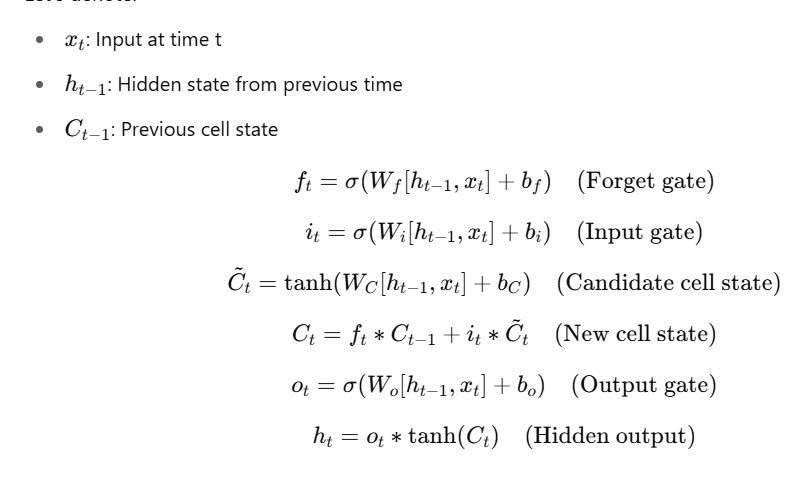
इसमें तीन मुख्य गेट्स (gates) होते हैं जो यह नियंत्रित करते हैं कि information कितनी रखनी है, कितनी भूलनी है, और कितनी बाहर भेजनी है।


🔹 LSTM Cell Diagram:

         ┌────────────┐
│ Forget │ → decides what to forget
x_t ──►──┤ Gate ├──┐
└────────────┘ │

┌────────────┐
│ Input │ → decides what new info to store
│ Gate ├──┐
└────────────┘ │

┌────────────┐
│ Cell State │ ← updated memory
└────────────┘

┌────────────┐ │
│ Output │ └──→ h_t (output/hidden)
│ Gate ├──────►
└────────────┘

🔹 LSTM Equations:

Let’s denote:


🧠 3. GRU (Gated Recurrent Unit)

📌 Introduced by: Cho et al. (2014)

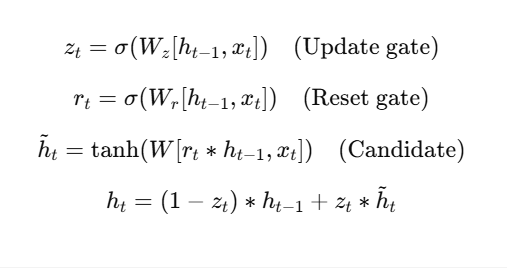
GRU को LSTM से सरल और तेज़ बनाया गया है। इसमें सिर्फ

दो gates होते हैं:

  • Update Gate (z)
  • Reset Gate (r)

GRU में अलग-अलग memory cell नहीं होता — hidden state को ही memory की तरह प्रयोग किया जाता है।


🔹 GRU Equations:

🔄 4. LSTM vs GRU – Comparison Table

FeatureLSTMGRU
Gates3 (Forget, Input, Output)2 (Reset, Update)
Cell StateYes (separate from h)No (merged with h)
ComplexityHigherLower
SpeedSlower (more parameters)Faster
PerformanceGood for longer sequencesComparable on many tasks
Use CaseText, speech, time-seriesSimilar, but with simpler models

🔧 5. PyTorch Example: LSTM and GRU

LSTM:

import torch.nn as nn

lstm = nn.LSTM(input_size=10, hidden_size=20, num_layers=1, batch_first=True)
input = torch.randn(5, 8, 10)
h0 = torch.zeros(1, 5, 20)
c0 = torch.zeros(1, 5, 20)

output, (hn, cn) = lstm(input, (h0, c0))

GRU:

gru = nn.GRU(input_size=10, hidden_size=20, num_layers=1, batch_first=True)
output, hn = gru(input, h0)

📈 6. When to Use Which?

ScenarioUse
Complex dependenciesLSTM
Faster training neededGRU
Simpler datasetsGRU
Large vocabulary/textLSTM
Low memory environmentGRU

📝 Practice Questions:

  1. LSTM और GRU में क्या अंतर है?
  2. LSTM में Forget gate क्या करता है?
  3. GRU में Cell State क्यों नहीं होता?
  4. LSTM का output कैसे निकाला जाता है?
  5. LSTM और GRU के फायदे और नुकसान क्या हैं?

🎯 Summary

ModelMemoryGatesUse Case
RNNShortNoneSimple sequences
LSTMLong3Complex dependencies
GRUMedium2Fast + good performance